the 3-mph city: OR, WALKING AS METHOD [2025]
[URBAN HUMANITIES GLOBAL (UN)CONFERENCE 2]
I presented this syllabus as part of the roundtable, Towards Practices of Care and Transformative Pedagogies in the Urban Humanities. Other participants included Aiala Levy (Wabash College), Yang Yang (University of California - Los Angeles), Cyndi Brandenburg and Mike Kelly (Champlain College), May Khalife (Miami University), and Derek Handley (University of Wisconsin - Milwaukee).
CONFERENCE PROMPT:
At this critical juncture of the urban humanities, we ask: what are the key and emerging practices driving the urban humanities today? How are the entanglements of disciplines, landscapes, histories, movements, narratives—and more—bringing to light overlooked, underwritten, or previously unknown histories concerning urban places? What still needs to be filled, addressed, and imagined? Each of our respective relationships and varying approaches to urban humanities practice, situated in our embodied and site-specific knowledge, will inform our collective response to these questions.
ROUNDTABLE ABSTRACT:
This roundtable session invites the audience to engage in a reflective discussion on ethical and creative pedagogical practices within urban humanities. Presenters will share a wide range of experiences and proposals that blend historical research, embodied fieldwork, thick mapping, and curricular transformation, shedding light on how pedagogy can become a civic practice and a political agent.
The projects highlighted in this session span multiple methods, ranging from walking-based inquiry and sensory ethnography to collective mapping rooted in post-disaster recovery, as well as archival research that uncovers structural racism in housing. These pedagogies encourage students to document, interpret, and intervene in urban space with care and accountability. Some initiatives build institutional infrastructure to support community-engaged teaching; others challenge students to confront the complex histories of resistance, segregation, and resilience through place-based methods and multimodal storytelling.
The discussion will invite a collective reimagining of pedagogy’s role toward transformative forms of humanistic practices. Key questions include: How do we recognize and responsibly engage with “community”? In what ways can mapping act as a civic gesture of care, especially in contexts marked by trauma and erasure? How do reflection and documentation become transformative acts of public scholarship? How can institutions support interdisciplinary, ethical teaching that prepares students for a meaningful engagement beyond the classroom? And how might students’ work live on—not just as coursework, but as contributions to justice, cultural memory, and social change?
SYLLABUS ABSTRACT:
Public Architecture is a collaborative initiative between the UCLA Department of Architecture and Urban Design, cityLAB, and the Center for Community Engagement to build departmental capacity to support community-engaged teaching. As part of our shared commitment to shape students into engaged citizens and citizen leaders, the collaborative initiative integrates and expands engaged scholarship into the Master of Architecture curriculum. Public Architecture will launch a series of methodological workshops for faculty and students in the Master of Architecture program and the Urban Humanities initiative in the 2025–26 academic year; these workshops will include an introduction to community engagement, as well as interactive sessions on spatial ethnography and critical cartography, archival analysis and visual documentation, filmic sensing and sound scavenging. My submission for the Urban Humanities Global (UN)Conference “Pedagogy” Roundtable is a prospective course titled “The 3-MPH City;” it would complement the aforementioned methodological workshops by introducing students to walking as a tool for place-based research and practice.
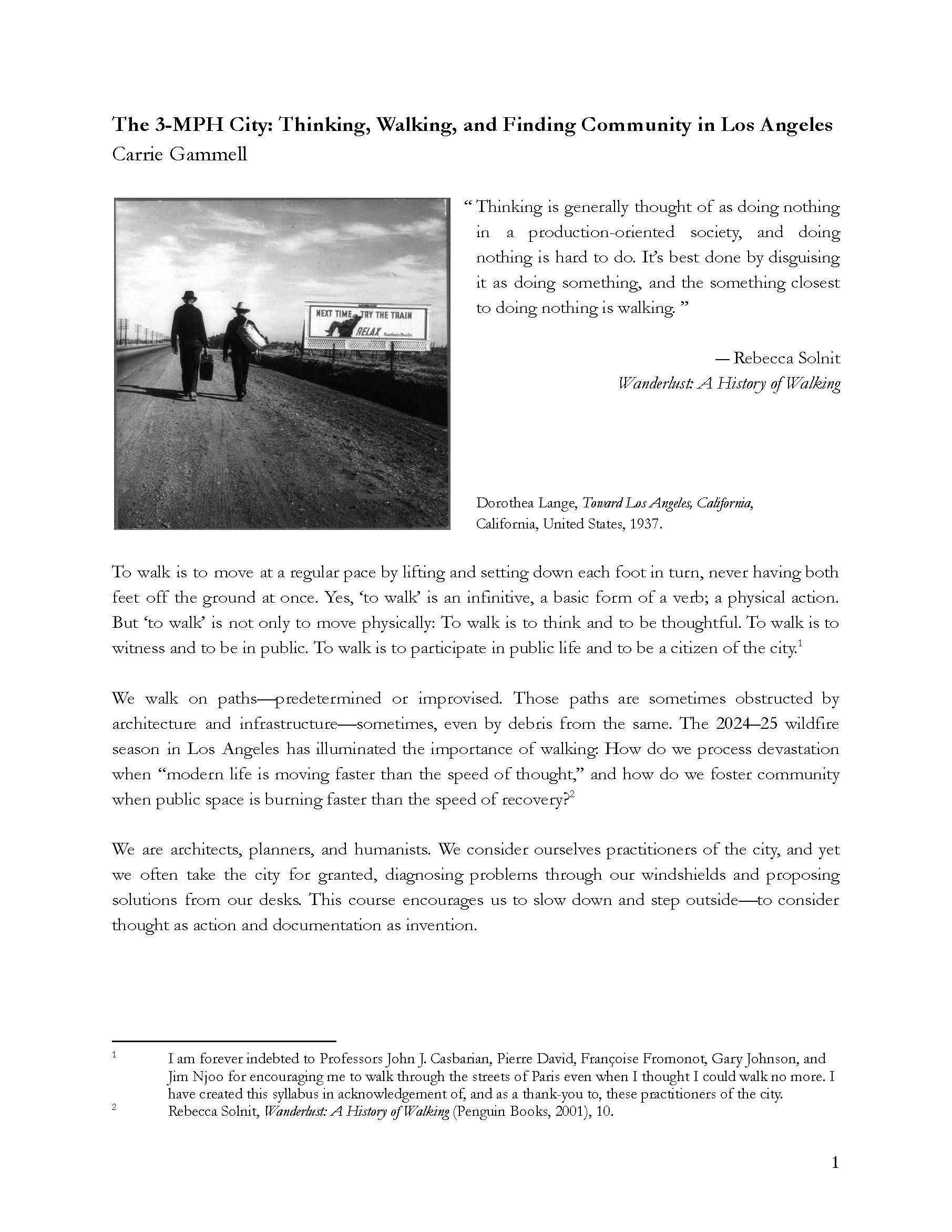
Missing—or perhaps, lost—from our understanding of cities and urban spaces is the process of moving through them slowly and deliberately. To walk is to move at a regular pace by lifting and setting down each foot in turn, never having both feet off the ground at once. Yes, ‘to walk’ is an infinitive, a basic form of a verb; it is a physical action. But ‘to walk’ is not only to move physically: To walk is to think and to be thoughtful. To walk is to witness and to be in public. To walk is to participate in public life and to be a citizen of the city. “The 3-MPH City” encourages students to think, walk, and find community amongst themselves, between buildings, and across Los Angeles. It asks, How can architects, planners, and humanists consider thought as action and documentation as invention?