HOUSING HISTORIES: AUTOCONSTRUCTION AND ARCHITECTURE IN BENEDICT CANYON [2026]
[REACT/REVIEW 6: IMAGINING THE LOCAL | READ THE ARTICLE HERE]
react/review is an annual peer-reviewed responsive journal dedicated to research by emerging scholars in art and architectural history and related fields. Affiliated with the Department of the History of Art & Architecture at the University of California, Santa Barbara, the journal is produced by graduate students and early career contingent scholars from across the UC system. This issue was edited by Megan J. Sheard and Taylor Van Doorne.
I presented an earlier version of this paper at the Art History Graduate Student Association (AHGSA) Graduate Student Symposium, on May 6, 2025. The symposium was organized by Dhaval Chauhan, Alida Jekabson, and Nathan Segura.
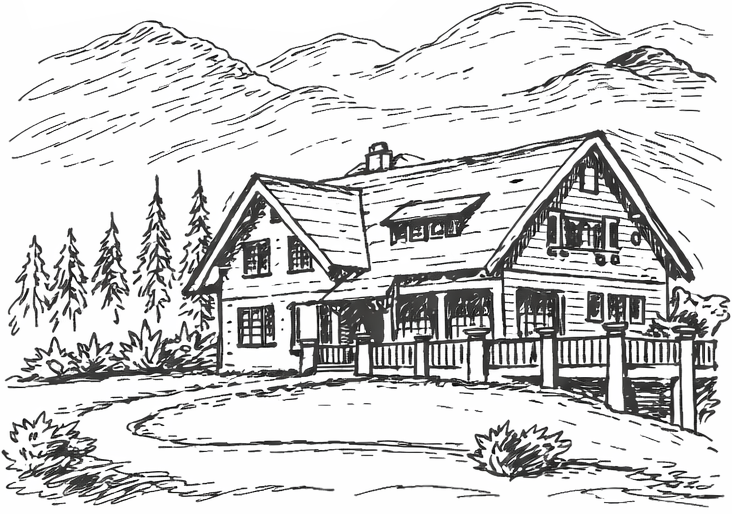
Home for Lee A. Phillips by Horatio Cogswell. Digital sketch by the author, 2026. See also:
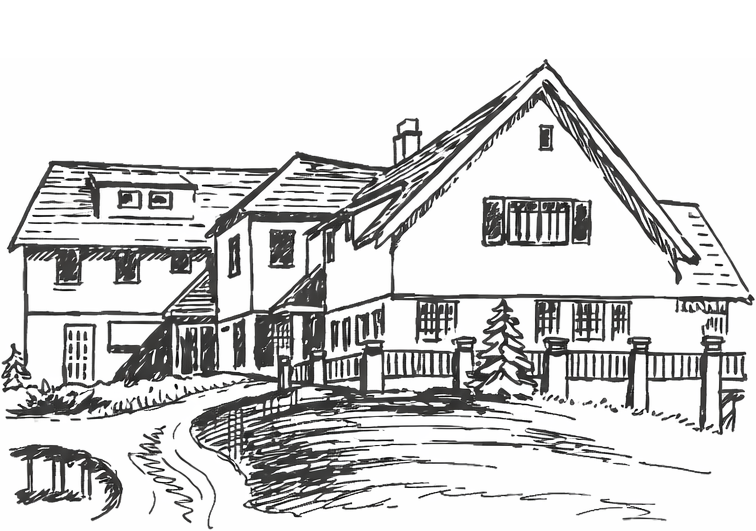
Home for Douglas Fairbanks by Max Parker. Digital sketch by the author, 2026.
ISSUE ABSTRACT:
From its emphasis as a nexus of action in the early environmental movement to Walter Mignolo’s use of “local histories” to critique colonial epistemologies (2000), the concept of the local has come to embrace place-based identities, neighborhood activism, community archiving, and microhistories. Theorizing the local provokes master histories that rely on center-periphery narratives, resulting in greater attention to the contingencies of neighborhoods, ecological regions, and cultural specificities. Such challenges may come from the Global South or the marginalized spaces of the so-called West, producing new forms of interrogation (Chakrabarty 2000; Crane 2011; Quayson 2014, 2025). Indigenous writers such as Potawatomi botanist Robin Wall Kimmerer (2013) and the Yolŋu Gay’wu Group of Women (2019) also foreground the unassimilable qualities of place through emphasizing the body of the land within webs of relatedness, while restitution claims interrogate the meanings of architectural interventions and object display. In architectural history, local sites and small spaces have been mobilized to produce new ways of reading both urban and rural environments. For example, Arijit Sen’s community-engaged fieldwork methods challenge narratives that marginalize neighborhoods in Milwaukee affected by disinvestment, while Swati Chattopadhyay examines how small spaces allow us to rethink empire (2023).
The editors of react/review—a peer review, open-access digital journal dedicated to research by emerging scholars––seek articles, reviews, and research spotlight essays for Volume 6 that consider the themes of local placemaking, the vernacular, and their imaginaries. How have makers imagined and engaged with the materials and landscapes of their community? How have community-engaged or non-professional projects produced narratives and aesthetics of the local? How might histories of the local resist generalization while also avoiding the insularity of “regional studies”? How might scholars develop methodologies for reading specific locales that can serve as models for understanding other places, such as Ato Quayson’s urban studies class using Accra to build a method for analyzing African and global cities (Quayson 2014, 2025)?
Though local histories have been excavated for nationalist and state-building purposes, this volume seeks instead to center histories of and critical approaches to local placemaking and its imaginaries. We are particularly interested in examples and sites outside of canonical histories, rather than the way that locales and vernacular practices have been appropriated into professional practice.
We invite scholarship on any historical period and geographical focus that engages with the volume’s theme. The journal is open to all submissions from fields related to art history, architectural history, urban studies, museum studies, and visual studies, but we prioritize articles by advanced graduate students, postdoctoral fellows, and early career contingent scholars.
ARTICLE ABSTRACT:
In a 2021 retrospective of Wallace Neff’s long and prolific career as a residential architect, historian Eleanor Schrader praised him for “[his] ability to combine Spanish, Tuscan, Mediterranean, Islamic, and other design elements… seamlessly into something he called ‘The California Style.’” Neff gained recognition for his celebrity commissions, many of which were located in the picturesque Benedict Canyon, a luxury Beverly Hills neighborhood with mature trees and winding streets.
The Art, Design & Architecture Museum at the University of California Santa Barbara hosts an archive of Neff’s work, which is integral to Southern California’s canon—a canon shaped more by the industrial wealth of Hollywood elites than by the agricultural enterprise of migrant workers. Yet, Benedict Canyon was named by and for Edson A. Benedict, a farmer whose family made settlement on the land and built a house thereon. This paper uses land entry files—in other words, U.S. General Land Office records that document the transfer of public lands to settlers—to reconstruct and recenter Benedict Canyon’s early residences in Southern California’s architectural history. It argues that although these early residences were designed and built by and for non-professionals, they, too, are integral to the region’s turn-of-the-century imaginary.
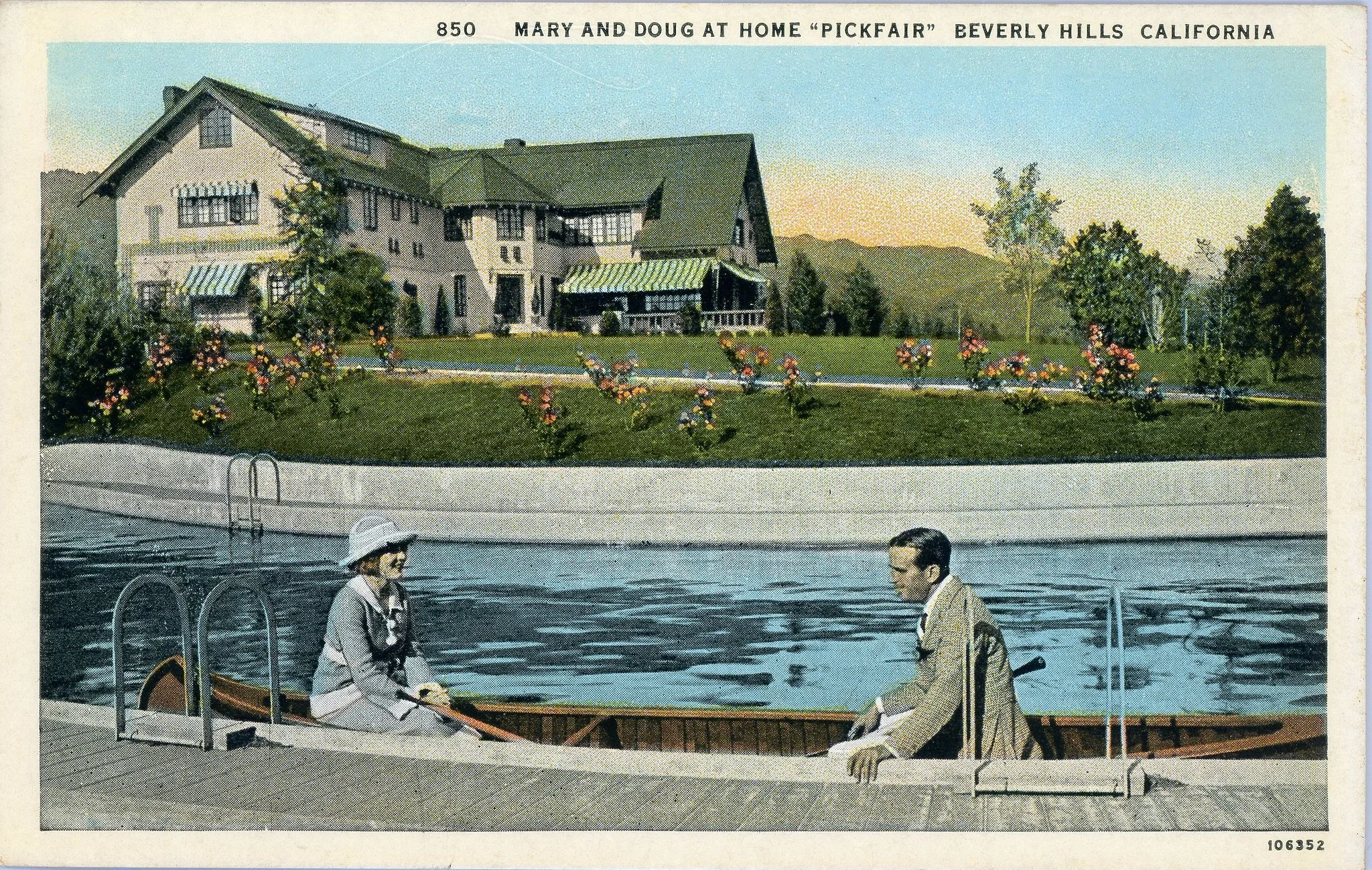
850 Mary and Doug at Home, “Pickfair,” Beverly Hills, California, c. 1932. Courtesy of Phillip Pessar.