THE AMERICAN WOMAN’S HOME SWEET HOME [2023]
[THRESHOLDS 51: HEAT | READ THE ARTICLE HERE]
Thresholds is the annual peer-reviewed journal produced by the MIT Department of Architecture, held in over 150 university art & architecture libraries around the world. Content features leading scholars and practitioners from the fields of architecture, art, and culture. This issue was edited by Hampton Smith and Zachariah DeGiulio.
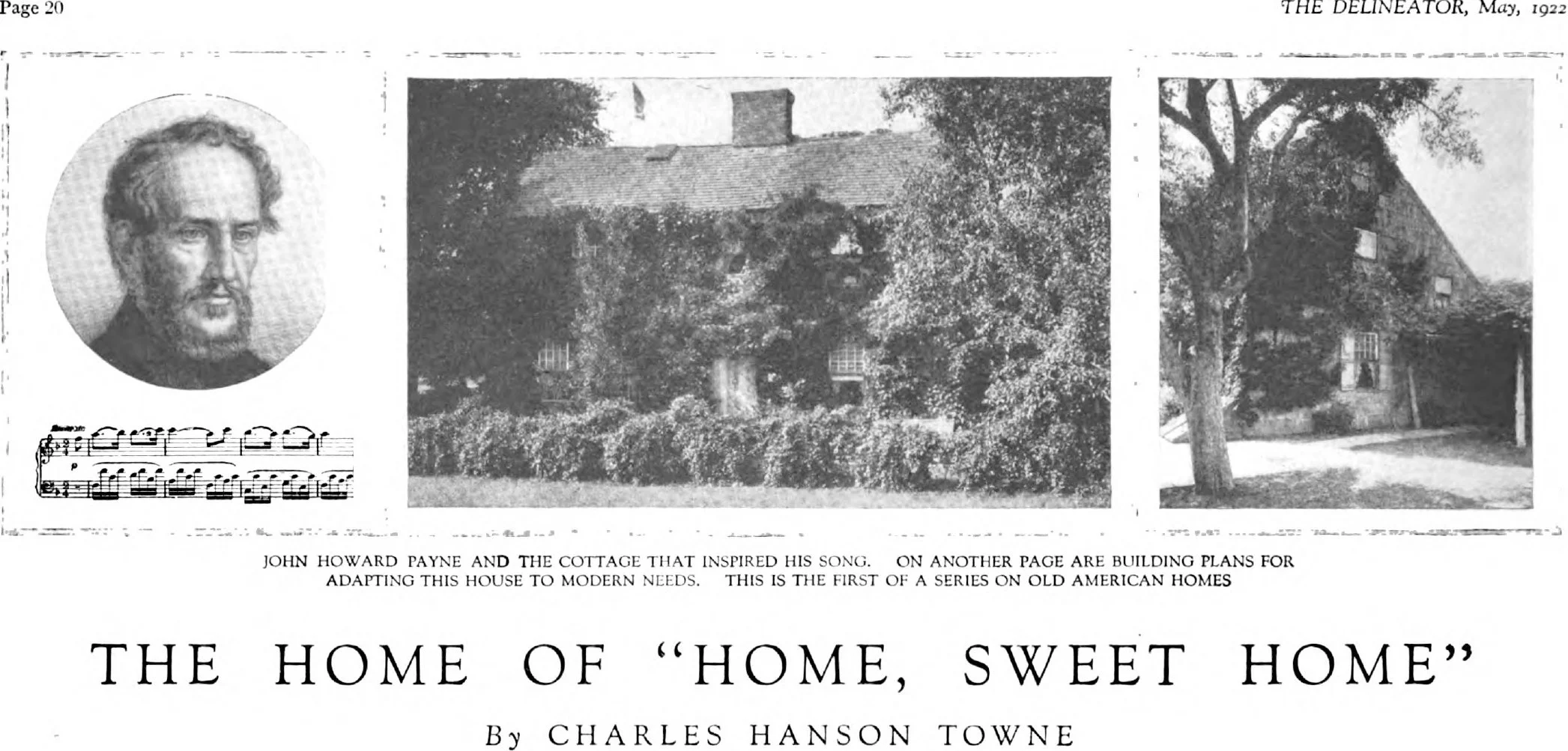
Charles Hanson Towne, “The Home of ‘Home, Sweet Home,’” The Delineator 100, no. 4 (May 1922): 20.
ISSUE ABSTRACT:
Heat is elusive: always on the move, always fugitive. Though we have many signs of its presence—sweating, “hot” and “cool” media, sitting under the shade, catching fire—heat itself largely evades conventional forms of representation. As the transference of energy from one system to another, heat radiates and penetrates. Immanent and intense, heat binds and nourishes as much as it reshapes or destroys. While helping us navigate the material world as tool, medium, and affect, heat forces us to come to terms with the fragility of the systems in which we take part. And though temperature is regularly mapped across graphs and thermometers, the feeling of heat is often so localized and so personal that it evades historic perception altogether. Even if we know things are hotter now than they were yesterday, where is heat within art and architecture practice?
Thresholds 51: Heat takes enthalpy—the thermodynamic property that comprises heat, pressure, and volume to effect chemical state change—as its guiding principle. We seek scholarly writing, artistic interventions, and criticism from art, architecture, and related fields to apply pressure within the volume to effect disciplinary state change. We aim to discover the ways art and architecture have historically navigated, wielded, and avoided heat.
Courtyard buildings across the Islamic world produce thermal delight; Mande blacksmiths carefully wield heat to make iron tools for repairing and nourishing communities; museum conservators curate temperature-controlled environments for artworks; Yurok practices of fire stewardship regulate natural rhythms of growth and decay. And though thermodynamic flux underlies such practices of making and maintenance, heat just as frequently effaces or prevents knowledge production—think of the conflagration of the University of Cape Town’s special collections or mold consuming boxes of archival material.
Recognizing that heat has never been evenly felt, from the violently racialized fictions of the “torrid zone” to the lack of adequate shade in urban communities, we are particularly invested in alternative architectural or aesthetic mobilizations of heat—in the contestation of thermal violence, in the activation of ritual, or in the warmth of community, desire, and lust. A critical account of heat within art and architecture must attend to its use as a medium and structure of violence, while nevertheless exploring how “feeling the heat” productively links scales of being, practices, and types of labor.
ARTICLE ABSTRACT:
Although the phrase “home, sweet home,” dates to an “old tradition” at Winchester College in England, it was John Howard Payne’s 1823 reinterpretation that became a cornerstone of Anglo-American culture. From subsequent popular recordings by John Yorke AtLee, Harry Macdonough, Richard Jose, Alma Gluck, Alice Nielsen, and Elsie Baker to the scores of The Wizard of Oz and The King and I, the song’s sentimental lyrics have recentered the public imagination around American exceptionalism and the American dream during periods of existential crisis and moral panic. Similarly, although the saltbox house dates to English colonization, it was a series of nineteenth- and twentieth-century reinterpretations that became models for the American family home. Be it a functional open fire or a decorative compliment to steam heating, the subtype’s central hearth has reoriented veterans, women, and immigrants around Puritan values during times of political conflict and economic uncertainty. This paper traces, first, how the saltbox house at 14 James Lane, with its seventeenth-century central hearth, became synonymous with John Howard Payne’s Home Sweet Home, and, second, how John Howard Payne’s supposed Home Sweet Home, with the help of twentieth-century club women, became synonymous with the National Better Home. It argues that the capacity for one cottage to advance simultaneously religious and nationalist, collectivist and individualist, revolutionary and anti-revolutionary politics, reveals the dependence of architecture upon active participants to transform a provincial object into an American icon.