THESIS, ANTITHESIS, SYNTHESIS
HP 8920. Special Topics: Thesis, Antithesis, Synthesis (3)
Seminar dedicated to intensive exploration of timely topics in historic preservation. Preq: Enrollment in MSHP program and HP 8080.
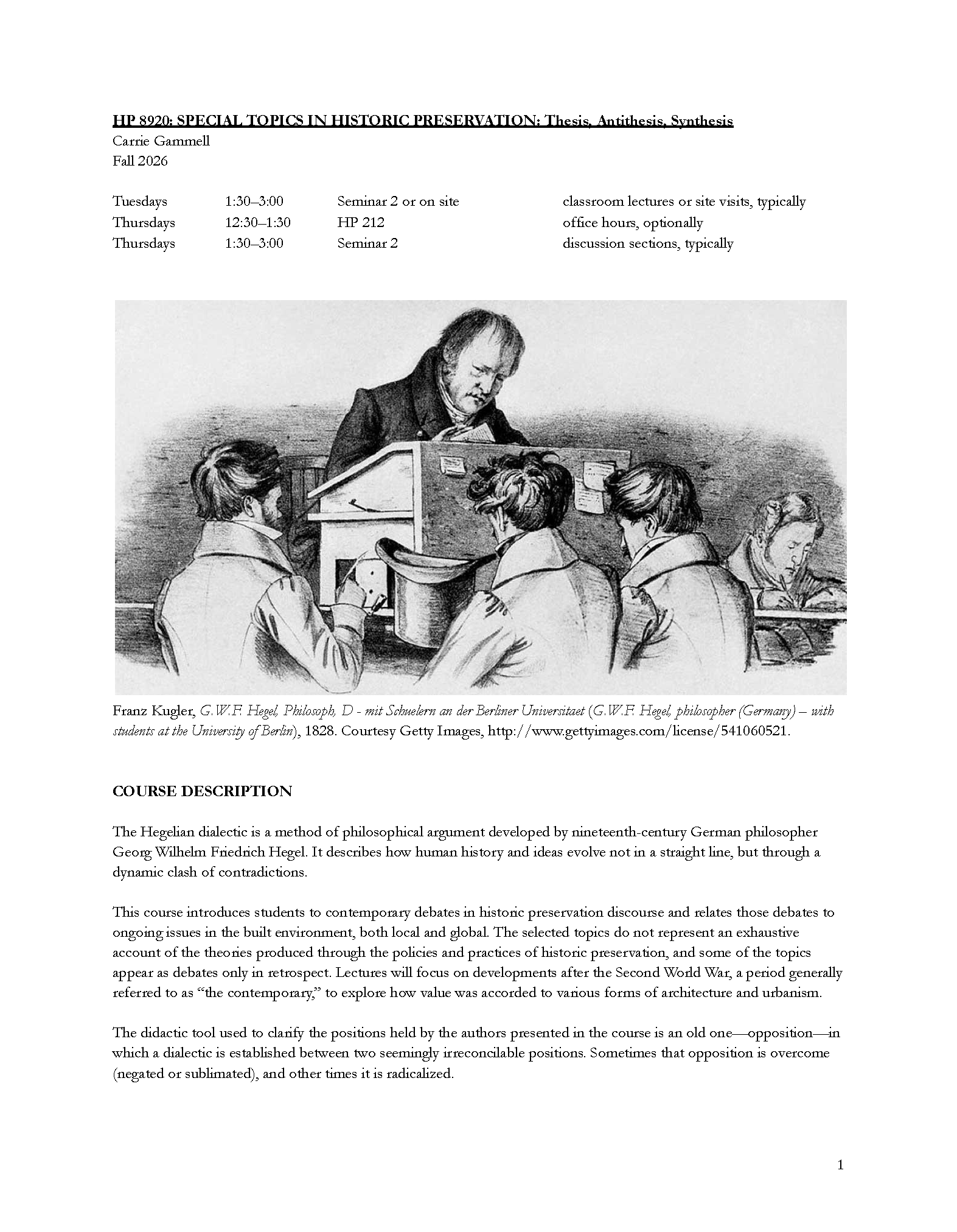
The Hegelian dialectic is a method of philosophical argument developed by nineteenth-century German philosopher Georg Wilhelm Friedrich Hegel. It describes how human history and ideas evolve not in a straight line, but through a dynamic clash of contradictions.
This course introduces students to contemporary debates in historic preservation discourse and relates those debates to ongoing issues in the built environment, both local and global. The selected topics do not represent an exhaustive account of the theories produced through the policies and practices of historic preservation, and some of the topics appear as debates only in retrospect. Lectures will focus on developments after the Second World War, a period generally referred to as “the contemporary,” to explore how value was accorded to various forms of architecture and urbanism.
The didactic tool used to clarify the positions held by the authors presented in the course is an old one—opposition—in which a dialectic is established between two seemingly irreconcilable positions. Sometimes that opposition is overcome (negated or sublimated), and other times it is radicalized.